Homeowner guide
Advantage ConcreteConcrete vs. Pavers for a Driveway
A driveway carries more weight than any other surface around a house, and it carries it every day. Concrete and pavers can both work as a driveway, but they handle cars, slopes and wear in different ways. Here's how the two compare when a driveway is on the table.
What a driveway asks of any surface
A driveway carries the weight of cars, and sometimes heavier vehicles, at the points where tires roll, turn and stop. It sits at the edge of the property where water runs off the street and the house. It often slopes. Whatever it's made of, it needs a firm, well-prepared base and a plan for where water goes.
Base, Thickness and Reinforcement in a Concrete Driveway explains why the base matters so much.
How each spreads the weight
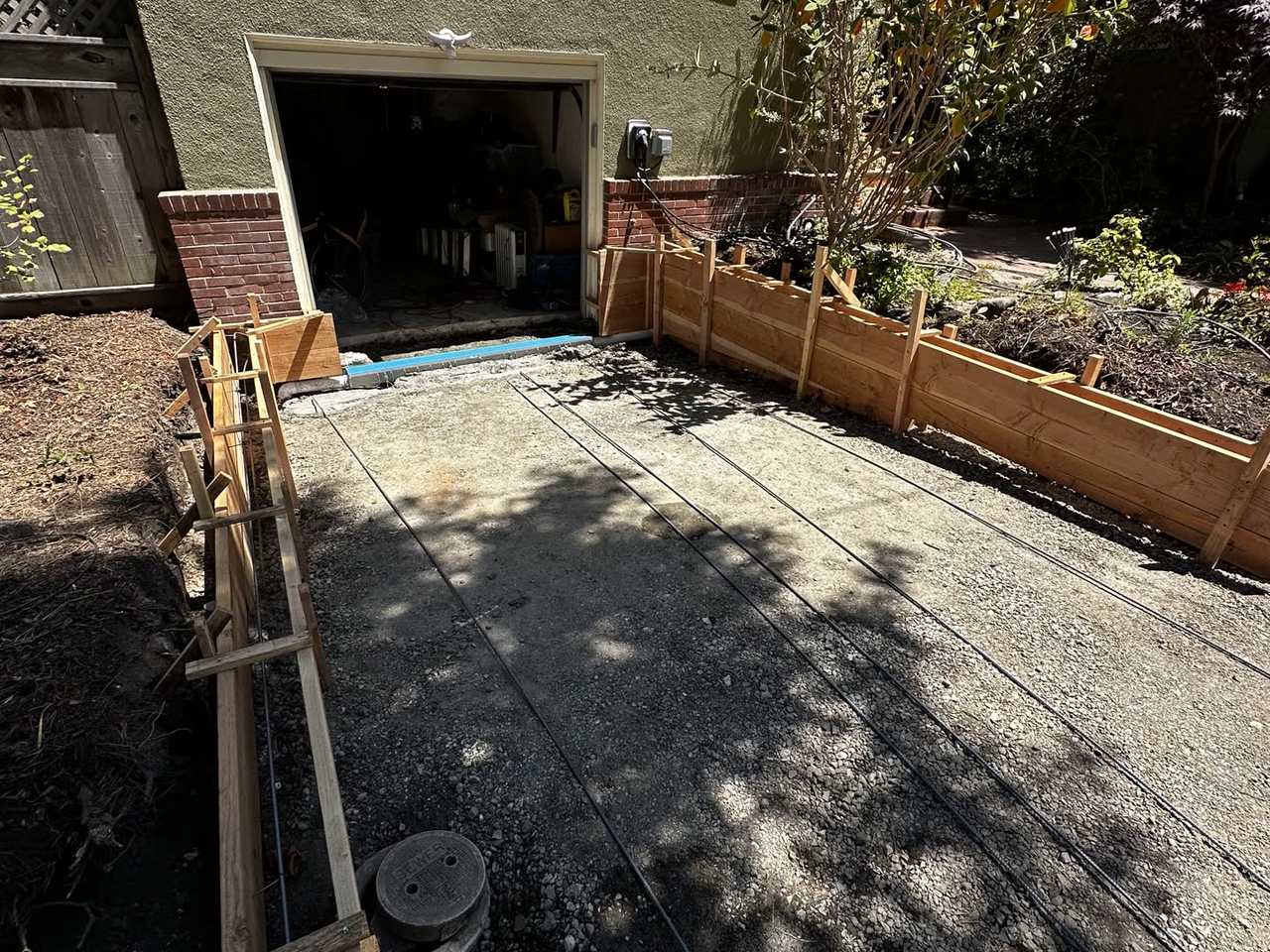
A concrete driveway is a single slab with reinforcement inside. When a tire presses on it, the slab spreads that weight across a wide area of the base. Thickness and reinforcement are matched to the load.
A paver driveway spreads weight through many interlocking pieces and the base beneath them. It relies heavily on the base and the edging to keep the pieces locked together. If the base or edging gives, pieces can shift under the weight.
Turning tires
Tires turning in place push sideways on the surface. On a concrete slab, that force is spread through the slab. On pavers, turning tires can push pieces sideways over time, especially near the edges and where cars turn in from the street. Edging matters a lot on a paver driveway for that reason.
Slopes
On a sloped driveway, grip and holding shape both matter. A broom-finished concrete driveway gives good grip for tires and feet. Forms hold the slab in shape while it's poured. Pavers on a slope can creep downhill over time if the base and edging aren't firm. Planning a Concrete Driveway on a Hillside Lot covers sloped driveways in more detail.
Oil, stains and wear
Both can stain from oil and other spills. On concrete, stains sit on a continuous surface. On pavers, a badly stained piece can be lifted and replaced, though new pieces may not match faded ones. Wheel paths can show wear on either one over time.
Settling and cracking
If the ground under a concrete driveway moves, the slab can crack, often along a joint, and sections can drop. If the ground under a paver driveway moves, individual pieces sink or lift, leaving ruts or bumps but no cracked slab.
Either way, good base preparation and a plan for water are the best defense.
Weeds and joints
A concrete driveway has joints spaced across it, with solid surface between them. A paver driveway has joints between every piece. Those joints can grow weeds, and joint material can wash out and need topping up, especially at the low end where water runs.
Repairs
A paver driveway can be repaired by lifting the affected pieces, fixing the base and relaying them. A concrete driveway is repaired by breaking out the affected section and pouring a new one. New concrete won't match the old in color.
In the East Bay, rain matters more than cold
In the East Bay, the main weather a driveway faces is rain, not freezing. Heavy winter storms send a lot of water down sloped driveways and across the base at the low end. Concrete sheds that water across its surface, so the slope has to send it somewhere sensible. Pavers let some water through the joints into the base, so the base has to handle it without washing out. Either way, the plan for water is as important as the surface itself.
Where the driveway meets the street
The approach where the driveway meets the street carries the hardest wear of all. Many cities have their own requirements for how approaches are built, so it's worth asking your city before deciding what the approach is made of. What a Driveway Approach Is, and Where It Meets the Street explains more.
A quick comparison
Side by side for a driveway:
- Concrete: single reinforced slab, spreads weight widely, good grip with a broom finish, repaired by section
- Pavers: many interlocking pieces, relies on base and edging, can shift under turning tires, repaired piece by piece
- Both: depend on the base, need slope and a plan for water, show wear in wheel paths
Getting started
Advantage Concrete pours concrete driveways, broom or stamped. Concrete vs. Pavers, Explained has the full side-by-side. If concrete sounds right for your driveway, tell me about the job, and the free estimate will describe the base, thickness, reinforcement, slope and finish. Concrete Driveways has more on the work.
Tell me about the job
The estimate is free, with no pressure and no obligation. Send the form and you'll hear back about your free estimate.
What happens next
- 1You send the form
- 2You hear back about the job
- 3You get a free estimate
- 4You decide
Request Your Free Estimate
Your details are used only to reply to your request. See the Privacy Policy.