
Homeowner guide
Advantage ConcreteHow Patio Slope Keeps Water Away From the House
A good patio looks flat, but it isn't. It's built with a gentle slope that most people never notice until they see water running off it in the rain. That slope is one of the most important details on any patio next to a house. Here's why it matters and how it's planned.
Why a patio can't be truly flat
Concrete doesn't soak up water. Rain that falls on a perfectly flat slab has nowhere to go, so it sits in puddles, spreads to the edges unevenly and finds its own way off. Often that way is toward the house, because the ground near a house tends to settle over time.
A slight, even slope gives water a clear direction. The slope is gentle enough that furniture sits steady and you don't feel it underfoot, but steep enough that water runs off instead of pooling.
Why water near the house is a problem
Water that runs toward the house collects against the foundation. Over time that can soak the ground under the foundation, find its way into crawl spaces or basements, and keep the base of walls damp. Water pooling at a back door can also run under the threshold.
Sending water away from the house is the main job of patio slope. The slab is set to fall away from the house toward the yard, so rain moves outward from the walls.
Where the water goes next
Getting water off the patio is only half the plan. It also has to land somewhere sensible. If the patio slopes toward a lawn or a planting bed that can take the water, that's often enough. If it slopes toward a fence, a neighbor's yard, a walk or a low spot that floods, the plan needs to change.
Sometimes the ground beside the patio needs shaping so water keeps moving away. The plan for the water is settled before the pour, along with the slope itself.
The slope starts underneath
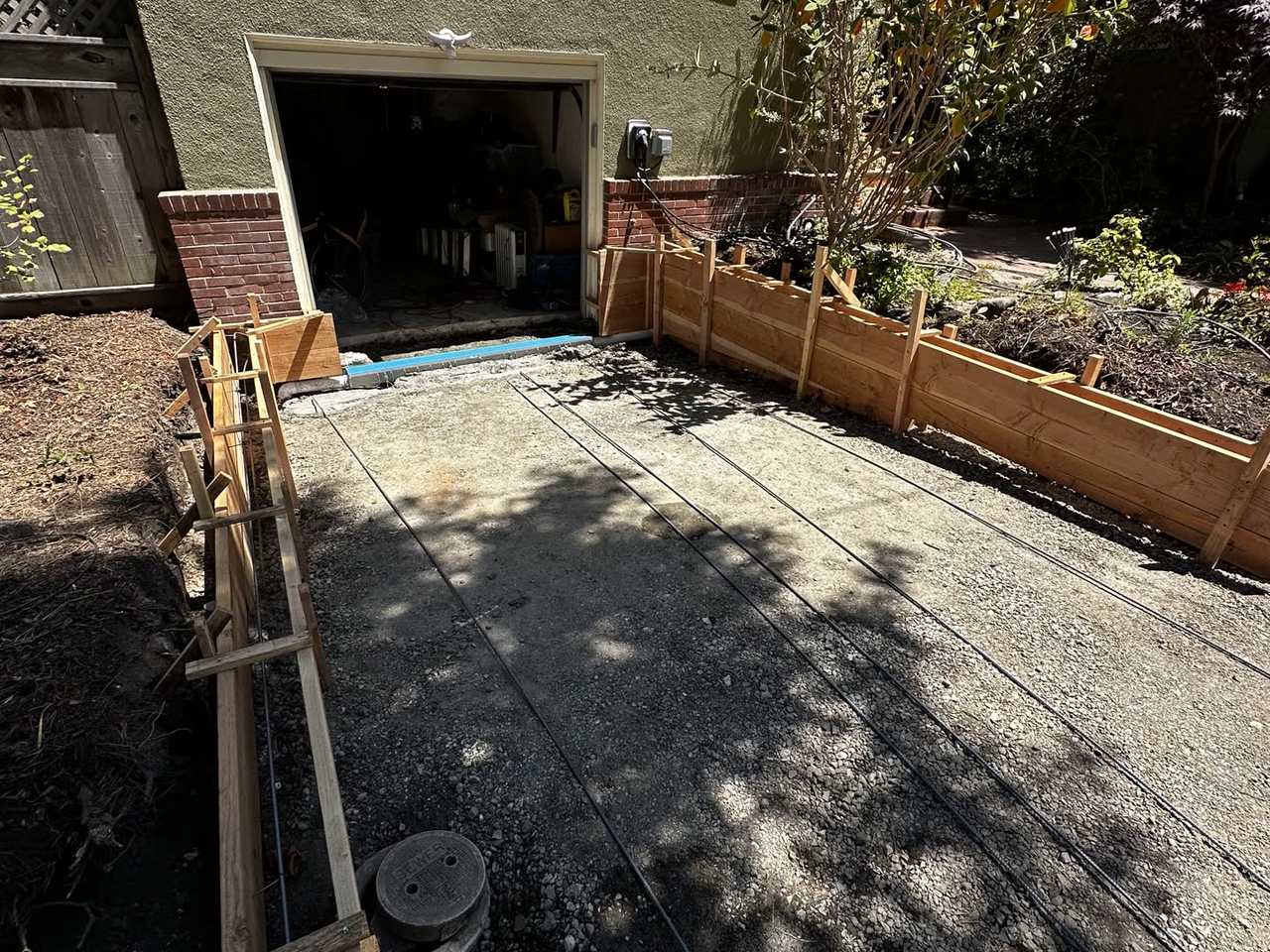
The slope of the finished surface comes from the base and the forms. Once the old surface is removed, the ground is shaped to the planned slope and compacted. Forms are set to the right heights at each edge, and the concrete is leveled to them. Getting the slope right at the base stage keeps the slab an even thickness from edge to edge.
Doors, thresholds and the house edge
Where a patio meets the house, the surface has to sit far enough below the door threshold that water won't run inside. Too close to the threshold, and wind-driven rain or a blocked drain can push water under the door. The height at the house edge is one of the first things settled when planning a patio.
If the patio is replacing an older one that sat too high or sloped the wrong way, this is a good chance to correct it.
Signs an existing patio slopes the wrong way
If you have an older patio, these signs suggest water is going the wrong way:
- Puddles that sit near the house after rain
- Water marks or damp along the bottom of the wall beside the patio
- A section near the house that has dropped lower than the rest
- Water running toward the back door instead of away from it
- Moss or mildew in one area that stays wet
Downspouts and other water sources
Rain falling on the patio is only one source of water. A downspout from the roof that empties onto or beside the patio can send far more water across it than the rain itself. Sprinklers, a hose bib or a slope in the yard above the patio can add more. When planning a patio, it helps to note every place water comes from, so the slope and the ground around the patio can handle all of it, not just the rain that lands on the slab.
Slope and finish
The finish affects how water moves too. A broom finish gives grip when the patio is wet, and water runs off it readily along the slope. A stamped surface has texture and grout-like lines in the pattern that water follows, so the slope still does the main work. Broom Finish or Stamped for a Patio? compares the two.
Getting started
When you tell me about a patio job, mention where water goes now when it rains, and include photos of where the patio meets the house. The free estimate will describe the slope and where water is sent. Concrete Patios has more on the work, and Planning a Concrete Patio Around How You'll Use the Yard covers the rest of the planning.
Services this guide relates to
Tell me about the job
The estimate is free, with no pressure and no obligation. Send the form and you'll hear back about your free estimate.
What happens next
- 1You send the form
- 2You hear back about the job
- 3You get a free estimate
- 4You decide
Request Your Free Estimate
Your details are used only to reply to your request. See the Privacy Policy.