Homeowner guide
Advantage ConcreteMatching Concrete Thickness to What It Has to Carry
A garden path and a driveway can look alike from above, but they're not built the same. What a slab has to carry decides how thick it should be and what goes inside it. Here's how thickness is matched to the load, and why the ground under the slab is part of the same decision.
Why thickness matters
Concrete is very strong when it's pushed down on evenly, and weaker when it bends. When weight presses on a slab, the slab spreads that weight across the ground beneath it. A thicker slab spreads weight over a wider area and resists bending better. A thinner slab bends more under the same weight, and if it bends too much, it cracks.
So the more weight a slab carries, and the more concentrated that weight is, the thicker it generally needs to be.
What different surfaces carry
Around a home, slabs carry very different loads:
- Garden paths and side paths carry people on foot, sometimes a wheelbarrow
- Front walks and patios carry people, furniture, grills and bins
- Sidewalks carry people, and sometimes a car pulling across at the driveway
- Driveways and approaches carry cars at the points where they roll, turn and stop
- Areas that see heavier vehicles carry more again
Matching thickness to the use
Each of those calls for a different slab. A path for feet doesn't need what a driveway needs. A driveway for everyday cars needs more than a patio. If a surface might see heavier loads in future, such as a parking pad that could take a larger vehicle or a walk a car might cross, that's worth planning for now.
The goal isn't to make everything as thick as possible. It's to match the slab to the job, so it holds up without using more material than it needs.
Reinforcement
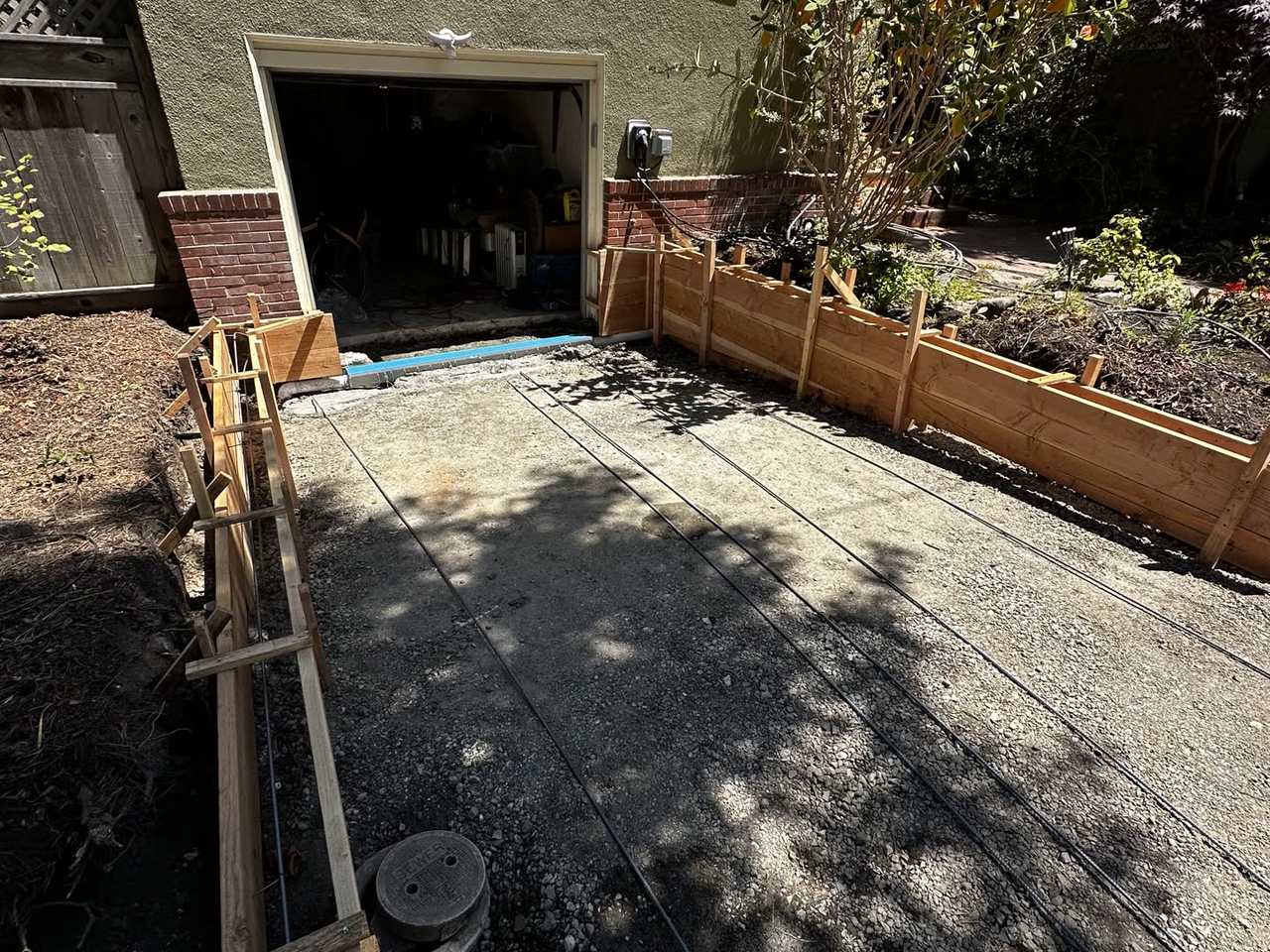
Reinforcement is steel placed inside the slab. It doesn't stop concrete from cracking, but it holds cracked pieces together and helps the slab carry weight across small weak spots. Slabs that carry more load generally get more reinforcement. For reinforcement to work, it has to sit within the slab, not on the ground under it.
Base, Thickness and Reinforcement in a Concrete Driveway goes deeper on driveways.
The ground decides as much as the load
The same slab behaves differently on different ground. On firm, well-compacted ground, the base carries much of the weight and the slab has less work to do. On soft ground, loose fill or clay that swells and shrinks, the slab has to bridge more and resist more movement.
That's why thickness is decided with the base in mind. Preparing and compacting the base properly is usually a better answer to weak ground than simply adding thickness on top of it.
Even thickness
A slab is only as strong as its thinnest spot. If the base under it is uneven, the slab ends up thinner in places, and those are where it cracks. Shaping the base carefully to the planned slope means the slab comes out an even thickness from edge to edge.
Edges and where loads land
Edges are weaker than the middle of a slab because there's concrete on only one side. Where cars turn in, tires often run right along the edge of a driveway or approach. Planning for that, and giving edges firm support underneath, helps them hold up.
When surfaces with different loads meet
Around a house, surfaces with different loads often meet. A front walk crosses the end of a driveway. A patio meets a parking pad. A sidewalk runs across the driveway approach. Where a lighter slab meets a heavier one, the section where cars actually cross is the one that needs to be built for cars, even if the rest of the walk is built for feet. Planning those crossings up front avoids a thin slab cracking under tires.
Thickness in a written estimate
Thickness is one of the things a written estimate should state plainly, along with the reinforcement. If two quotes for the same driveway show different thicknesses, they're describing different slabs. Why Two Concrete Quotes for the Same Job Come Back Different covers how to compare them.
Questions worth asking
When you plan any slab, it's worth asking:
- What will this surface carry, now and in future?
- How thick will it be, and why?
- What reinforcement goes inside it?
- How is the base prepared to support it?
- How are the edges supported where loads land on them?
Getting started
When you tell me about the job, mention what the surface will carry, including any vehicles. The free estimate states the thickness and reinforcement for your slab. Choosing the Right Concrete for Your Property, Explained covers thickness along with finish and slope.
Keep reading
- How Much Concrete Work Costs in Oakland, ExplainedEvery cost driver in plain language, and why quotes differ.
- Concrete vs. Pavers, ExplainedA side-by-side look for patios, walkways and driveways.
- Choosing the Right Concrete for Your Property, ExplainedFinish, thickness, slope and doing the work in stages.
- Concrete FAQStraight answers to the questions homeowners ask most.
Tell me about the job
The estimate is free, with no pressure and no obligation. Send the form and you'll hear back about your free estimate.
What happens next
- 1You send the form
- 2You hear back about the job
- 3You get a free estimate
- 4You decide
Request Your Free Estimate
Your details are used only to reply to your request. See the Privacy Policy.