Homeowner guide
Advantage ConcreteGetting Concrete to the Work Area on a Tight or Sloped Lot
The easiest concrete job is one where the truck pulls up right beside the forms and the concrete goes straight in. Many East Bay homes aren't like that. Narrow streets, steep driveways, side yards and back yards behind the house all change how concrete reaches the pour. Here's how access is planned, and what you can do to help.
Why access matters
Concrete arrives in a truck, ready to place, and it has to go into the forms while it's still workable. Every step between the truck and the forms takes time and effort. When the truck can reach the pour, the job is straightforward. When it can't, the concrete has to travel, and that needs a plan.
Access also affects breaking out old concrete and hauling it away, bringing in base material and getting tools and forms to the work area.
When the truck can reach
Front work, such as a sidewalk, a driveway approach or a driveway, is often reachable from the street. Even then, it depends on parking, the width of the street, overhead wires and trees, and whether the truck can get close enough without blocking the street. A narrow hillside street with cars parked on both sides can make a short distance hard to cover.
When the work is behind the house
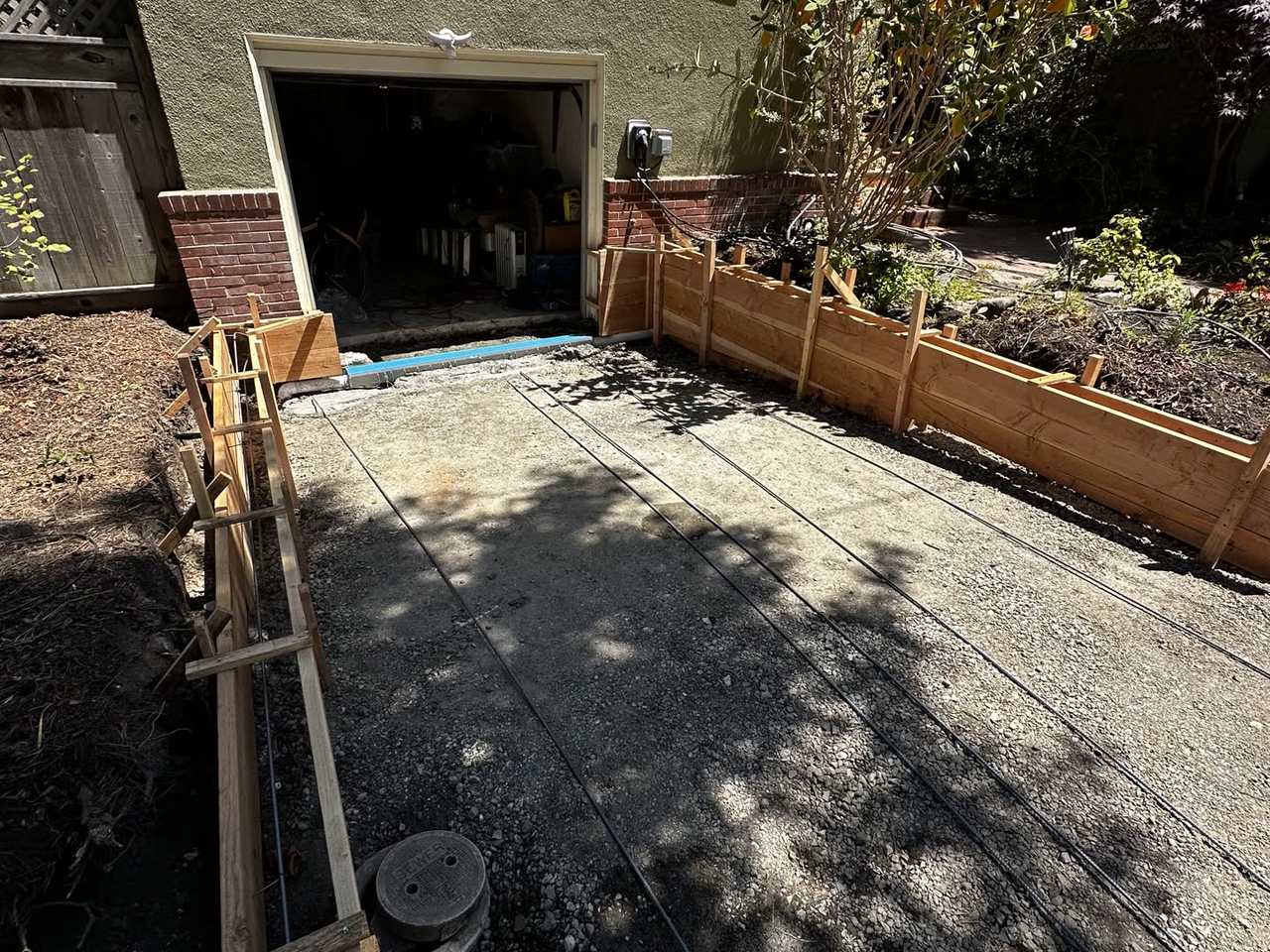
Back patios, side paths and retaining walls in the back yard usually can't be reached by a truck. Concrete has to get there another way. The two most common are wheeling it in by barrow along a clear route, or pumping it through a hose from the truck to the forms.
Wheeling works over short, level routes. Pumping is often used for longer routes, routes with steps or slopes, or where a lot of concrete has to move in a short window.
Side yards and gates
A side yard is often the only route to the back. Its width, any gate and anything along it, such as bins, meters, air conditioning units, plants and hoses, all decide what can get through. A narrow gate might mean smaller equipment, or a hose run instead of barrows.
If a fence section or gate can be opened wider, mention it when you tell me about the job.
Slopes and steps on the route
On a sloped lot, the route to the work area may climb or descend steeply, or include steps. Wheeling concrete up or down steps isn't practical, so pumping is often the answer. Steep routes also affect bringing in base material and taking out broken concrete.
Breaking out and hauling away
Access works in both directions. Old concrete that's broken out has to leave along the same route that new materials come in. On a tight lot, that can be as much work as getting the new concrete in. A written estimate should account for both.
How access shows up in an estimate
Because access changes equipment and labor, it's one of the things that moves an estimate the most. Two similar patios can be very different jobs if one is reachable from the driveway and the other is behind the house up a set of steps. What Pushes the Cost of Concrete Work Up, and What Brings It Down covers access alongside other cost drivers.
What you can do to help
A few things make access easier on the day:
- Move cars from the driveway and the street in front if you can
- Clear bins, pots, hoses and furniture from the route
- Unlock and open gates, and note any that are narrow
- Mention anything fragile along the route, such as plants or low walls
- Let neighbors know if the street or a shared driveway will be busy
- Keep pets and children clear of the work area and the route
Protecting the route
On the way to the work area, a route may cross lawns, walks or planting beds. It's worth asking how the route is protected and what to expect afterward, especially if it crosses something you care about.
What to share up front
Photos make access much easier to plan. Take one from the street showing where a truck would stop, one of the route to the work area including any gates and steps, and one of the work area itself.
Getting started
Tell me about the job and include those photos. The free estimate accounts for how concrete gets to the pour and how old concrete leaves. Planning Concrete Work in the East Bay, Explained covers access along with other planning questions.
Keep reading
- How Much Concrete Work Costs in Oakland, ExplainedEvery cost driver in plain language, and why quotes differ.
- Concrete vs. Pavers, ExplainedA side-by-side look for patios, walkways and driveways.
- Choosing the Right Concrete for Your Property, ExplainedFinish, thickness, slope and doing the work in stages.
- Concrete FAQStraight answers to the questions homeowners ask most.
Tell me about the job
The estimate is free, with no pressure and no obligation. Send the form and you'll hear back about your free estimate.
What happens next
- 1You send the form
- 2You hear back about the job
- 3You get a free estimate
- 4You decide
Request Your Free Estimate
Your details are used only to reply to your request. See the Privacy Policy.